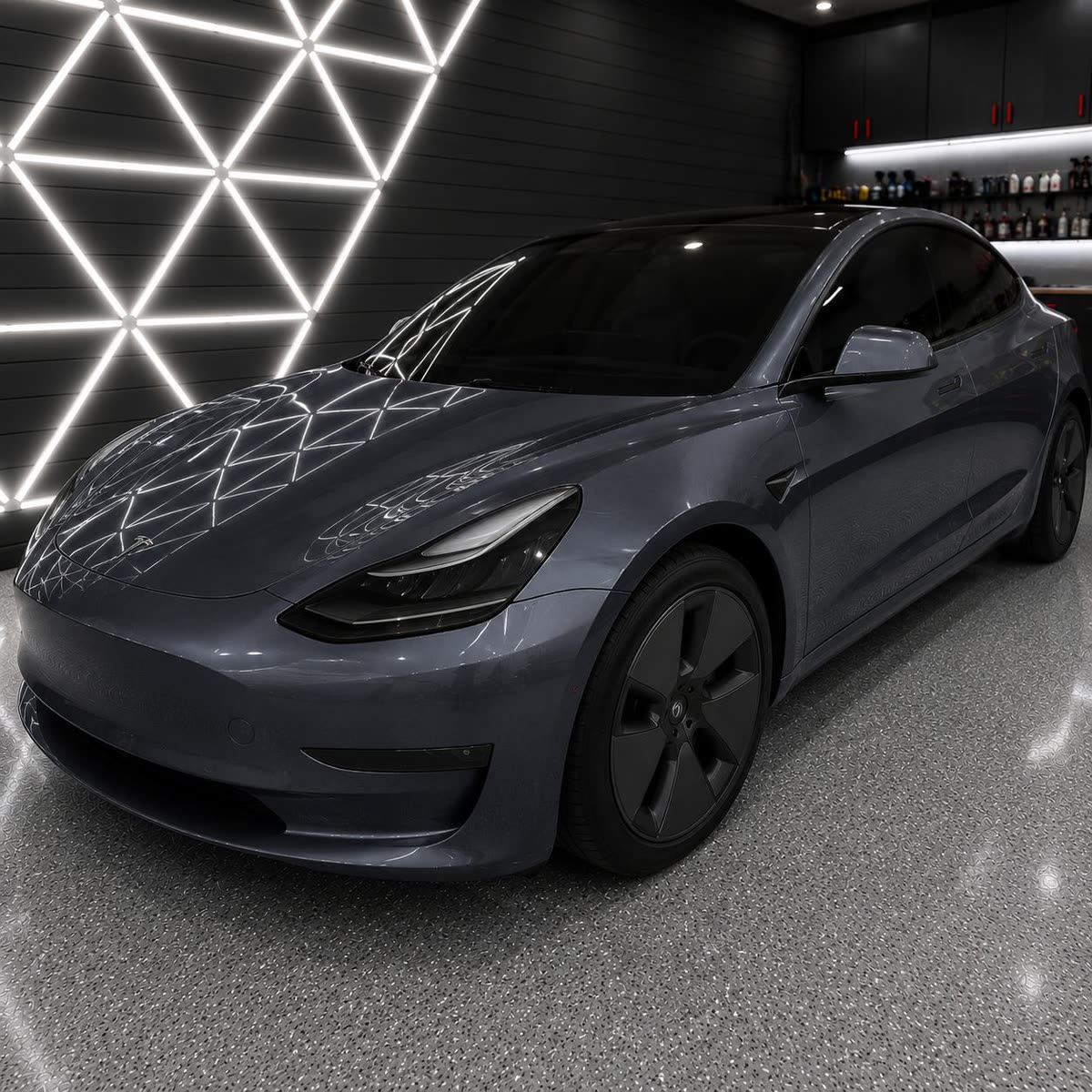
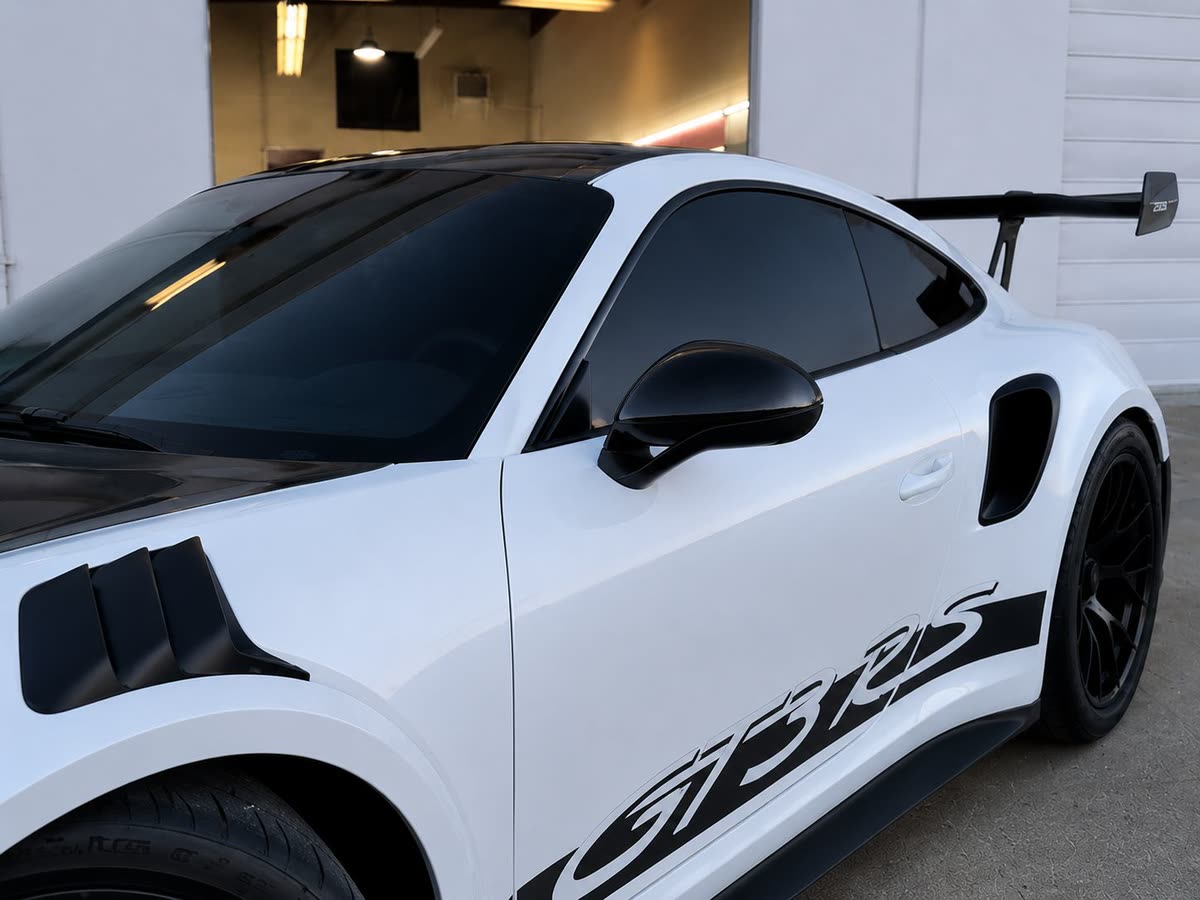
Read straight out of Vehicle Code § 26708 — not off a forum thread. What each piece of glass is allowed to carry, the two percentages everyone swaps around, and what to do if you are already holding a citation.
California does not write its tint law as a menu of approved shades. It writes it as a prohibition with holes cut into it. Subdivision (a)(1) of § 26708 is the whole foundation: “A person shall not drive any motor vehicle with any object or material placed, displayed, installed, affixed, or applied upon the windshield or side or rear windows.” A companion clause, (a)(2), reaches anything elsewhere in the car that obstructs or reduces the driver’s clear view through the windshield or side windows.
Framed that way, the useful question is no longer “how dark can I go?” It is “which numbered exception is my car standing on?” Every lawful tint job in this state traces back to one. If a shop cannot name the paragraph that covers the work it is selling you, that is worth noticing before the film comes off the roll.
You will see “70% legal tint” advertised for California front doors constantly. That figure is real, but it belongs to a different line of the statute — and it is not the spec of the film you buy.
Subdivision (d) governs the two front side windows, immediately left and right of the front seat. It permits clear, colorless, and transparent material only, and it stacks five conditions:
So the 88 is the spec of the roll. The 70 is the federal floor for the finished window, glass and film measured together. They describe different objects, and only one of them is something you order. The practical consequence is blunt: there is no legal 35%, 20% or 5% film for a California front door. The only relief the code offers is medical, and it is narrower than most drivers expect — see below.

Almost everything California polices sits in the front doors and the top band of the windshield. Behind the driver, the code steps back entirely — which is where most of the look you are after actually lives.
Four inches is a shop convention, and the AS‑1 mark etched into the glass is a manufacturer’s reference. Neither is the legal test California actually applies.
Subdivision (c) permits transparent material on the topmost portion of the windshield on four conditions. The first one carries all the weight, and it is worth reading word for word: “The bottom edge of the material is at least 29 inches above the undepressed driver’s seat when measured from a point five inches in front of the bottom of the backrest with the driver’s seat in its rearmost and lowermost position with the vehicle on a level surface.”
The reference point is the seat, not the roofline. That single detail is why the legal band is deep on a raised truck and shallow on a low-slung coupe, and why the same banner can pass on one car and fail on the next one in the queue. To check your own: seat all the way back and all the way down, vehicle on level ground, measure up from a point five inches ahead of the base of the backrest.
The remaining three conditions are easier to hold in your head. The material cannot be red or amber. It cannot carry opaque lettering, and whatever lettering it does carry must not distort vision or affect primary colors seen through the windshield. And it cannot bounce sunlight or headlight glare into the eyes of oncoming or following drivers any worse than the bare windshield would.
Subdivision (b)(4) says the section simply does not apply to side windows that are to the rear of the driver. No percentage is attached to that sentence. A 5% limo shade on the back doors of a sedan sits on exactly the same legal footing as leaving the glass bare.
The rear window comes with one condition. Under (b)(8), the section does not apply to it “if the motor vehicle is equipped with outside mirrors on both the left- and right-hand sides of the vehicle that are so located as to reflect to the driver a view of the highway through each mirror for a distance of at least 200 feet to the rear of the vehicle.” Two functioning side mirrors covering 200 feet — equipment nearly every modern car leaves the factory with — and the back glass is unrestricted.
This is the shape of a correctly built California car: dark from behind, close to factory from the front. That is not a compromise anyone settled for. It is the statute drawn in film.
Two provisions address medical need, and neither is a license for dark film on the front doors.
The first, § 26708(b)(10), permits a sun screening device on the side windows either side of the front seat where the driver or a front-seat passenger carries a letter or other document signed by a licensed physician and surgeon certifying that the person must be shaded from the sun due to a medical condition — or one signed by a licensed optometrist certifying the same for a visual condition. The statute adds that these devices shall not be used during darkness.
Note the word device. § 26708.2 defines what qualifies, and permanent film is not on the list. The device has to be held in place by means allowing ready removal from the window area — a frame, a rigid material with temporary fasteners, or a flexible roller shade. If it uses transparent material it must be green, gray or a neutral smoke in color, with a luminous transmittance of not less than 35 percent. If it works by louvers or an alternating opaque pattern, the pattern must be essentially uniform, at least 35 percent of the device area must be open, and no individual louver or opaque section may have a projected vertical dimension exceeding 3/16 inch. Either construction is capped at 35 percent reflectivity on the inner and outer surface alike.
The second, § 26708(e), allows clear, colorless material on the windshield, side or rear windows on the same 88 percent and FMVSS 205 terms as subdivision (d) — but here the certificate must be signed by a licensed dermatologist, certifying that the person should not be exposed to ultraviolet rays because of a medical condition.
§ 26708 is aimed at the person driving. § 26708.5 is aimed at whoever picks up the squeegee: no person shall place, install, affix, or apply any transparent material upon the windshield, or side or rear windows, if the material alters the color or reduces the light transmittance — except as provided in subdivisions (b), (c) or (d) of § 26708. Tinted safety glass is handled separately in (b) of that same section: it may be installed where it complies with U.S. Department of Transportation safety glazing standards and sits in a location those standards allow for that type of glass. That is the carve-out factory privacy glass rides on.
That is the reason a shop worth its reputation will talk you out of a shade on the front doors rather than take the money and hand you the problem. The obligation runs in both directions across the counter.
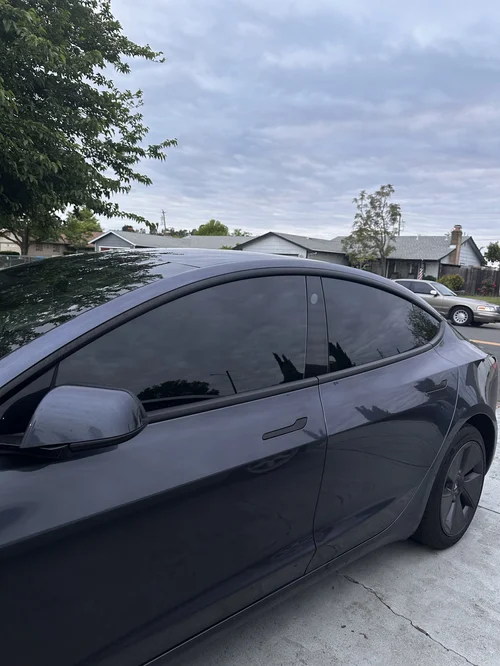
A tint stop under § 26708 is an equipment infraction, and California treats equipment infractions as correctable rather than final.
§ 40303.5(e) covers equipment infractions in Division 12, where § 26708 lives. The officer is to allow a promise to correct unless a disqualifying condition under § 40610(b) applies.
Almost always the front doors or the windshield band. Rear glass is rarely the reason the car got stopped.
Obtain proof of correction in the form § 40522 calls for — as prescribed in § 40616.
Present it by mail or in person on or before the date you promised to appear and § 40522 directs the court to dismiss. The clerk collects a $25 transaction fee per violation under § 40611(a).
Base fines and court assessments are set outside the Vehicle Code and vary by county, so the only figure worth trusting is the one printed on your own court notice.
§ 26708 is state law. There is no Hayward edition of it, no Alameda County amendment, and nothing a city council can loosen or tighten. A car built to the code here is held to the identical standard in San Leandro, Union City, Castro Valley, San Lorenzo, Fremont and Oakland, whether the stop is made by a city officer or by CHP.
Two things follow for East Bay drivers. If you moved in from a state that allowed a shade on the front doors, that shade did not travel with you — the front glass is the first thing to re-examine. And because the rear of the car is wide open under (b)(4) and (b)(8), there is considerably more room to build the look you want than most people assume. The restriction is concentrated in two windows and a strip of windshield; the rest of the car is yours.
If you would rather have it spec’d than guessed at, tell us the vehicle and we will walk the glass with you before anything is cut. Request a free quote or call the shop.
This page summarizes the Vehicle Code as an installer reads it and is not legal advice; the statute itself controls. § 26708 was last amended by Stats. 2025, Ch. 417 (SB 506), effective January 1, 2026.
No. Section 26708(d) permits only clear, colorless material on the front side windows, with a minimum visible light transmittance of 88 percent. A 35 percent film does not meet that standard on a passenger vehicle.
The code sets no darkness limit there. Section 26708(b)(4) exempts side windows to the rear of the driver outright, and Section 26708(b)(8) exempts the rear window as long as the vehicle has outside mirrors on both sides giving the driver a view of at least 200 feet to the rear.
At the 29-inch line. Section 26708(c)(1) requires the bottom edge of the material to sit at least 29 inches above the undepressed driver’s seat, measured from a point five inches in front of the bottom of the backrest, with the seat in its rearmost and lowermost position. Because it is measured from the seat, the depth of the legal strip differs from car to car.
Yes. Section 26708(d)(4) requires a certificate signed by the installing company, kept on the driver or inside the vehicle, confirming the windows meet that subdivision and naming both the installing company and the material’s manufacturer by full name and street address.
Tell us the vehicle and how you drive it. We will spec what California allows on each window and quote it before anything gets cut.
★★★★★ Rated 5.0 on Google · 500+ Cars Completed · Free & No-Obligation